Recent industry research points to a global structural shift in how financial
products are distributed: capital, credit, and insurance are decoupling from
monolithic banking applications and integrating directly into non-financial
commerce workflows.
In mature markets like the US and Europe, embedded finance has already evolved
into a multi-trillion-dollar transaction layer. The US market—driven by large
platform ecosystems, deep capital markets, and Banking-as-a-Service (BaaS)
infrastructure like Stripe and Cross River—is projected to process over $7 trillion
in embedded transactions. Meanwhile, Europe's market has been structurally unlocked
by regulatory frameworks like PSD2 (Open Banking) and GDPR, giving rise to global checkout
giants like Klarna and Adyen.
While the Western model largely focused on credit cards and point-of-sale BNPL overlaying legacy card networks,
India’s embedded finance trajectory is distinct. Powered by public rails like UPI, Account Aggregator, and ONDC,
financial services are shifting from destination products to native, context-aware micro-services embedded directly
within the checkout payload.
When a user opts for micro-duration travel insurance during checkout on MakeMyTrip or activates a 3-month no-cost EMI
on Amazon, financial services cease to exist as standalone products. By leveraging point-of-sale intent, digital
platforms are converting transaction friction into a projected $25 billion market opportunity in India. In this post-DPI
(Digital Public Infrastructure) landscape, the primary driver of fintech monetization is no longer broad customer acquisition,
but context-driven deployment at the exact moment of intent.
What Exactly is Embedded Finance (and How Does it Differ)?
To build a winning e-commerce strategy, platforms must avoid confusing contextless financial offerings with
true embedded fintech.
-
Cross-sell / Upsell: Contextless, outbound financial pushes. Example: Receiving a
random cold call or SMS from a bank offering a pre-approved ₹5 Lakh loan.
-
Embedded Finance: Contextual financial offerings presented during physical or
traditional commerce. Example: An electronics dealership offering loans or insurance directly
at the showroom.
-
Embedded Fintech: Technology-enabled, pull-based sales of financial products at the exact
digital point of commerce. It is highly context-relevant and often delivered as a low-ticket "sachet product"
(e.g., ticking a single box for opting no cost EMI at 1499/ month during TV set purchase checkout).
Why Does Embedded Finance Work for E-Commerce in India?
According to insights from Elevation Capital's report on embedded finance, the surge in adoption stems from three core advantages:
-
Massive Reach Over Traditional Banks: Digital consumer platforms engage with millions of active users daily,
giving them a reach that traditional banks struggle to match on their own.
-
Superior Consumer Trust: Consumers often place a higher degree of daily operational trust in their preferred
e-commerce platforms and delivery apps than in traditional financial institutions.
-
The Data Goldmine: E-commerce platforms possess rich insights into customer spending, buying frequency, and
lifestyle patterns. Banks and insurers eagerly partner with these platforms to offer better-informed, pre-approved
credit limits or contextual policies.
The 3 Platform Benefits Driving E-Commerce Adoption
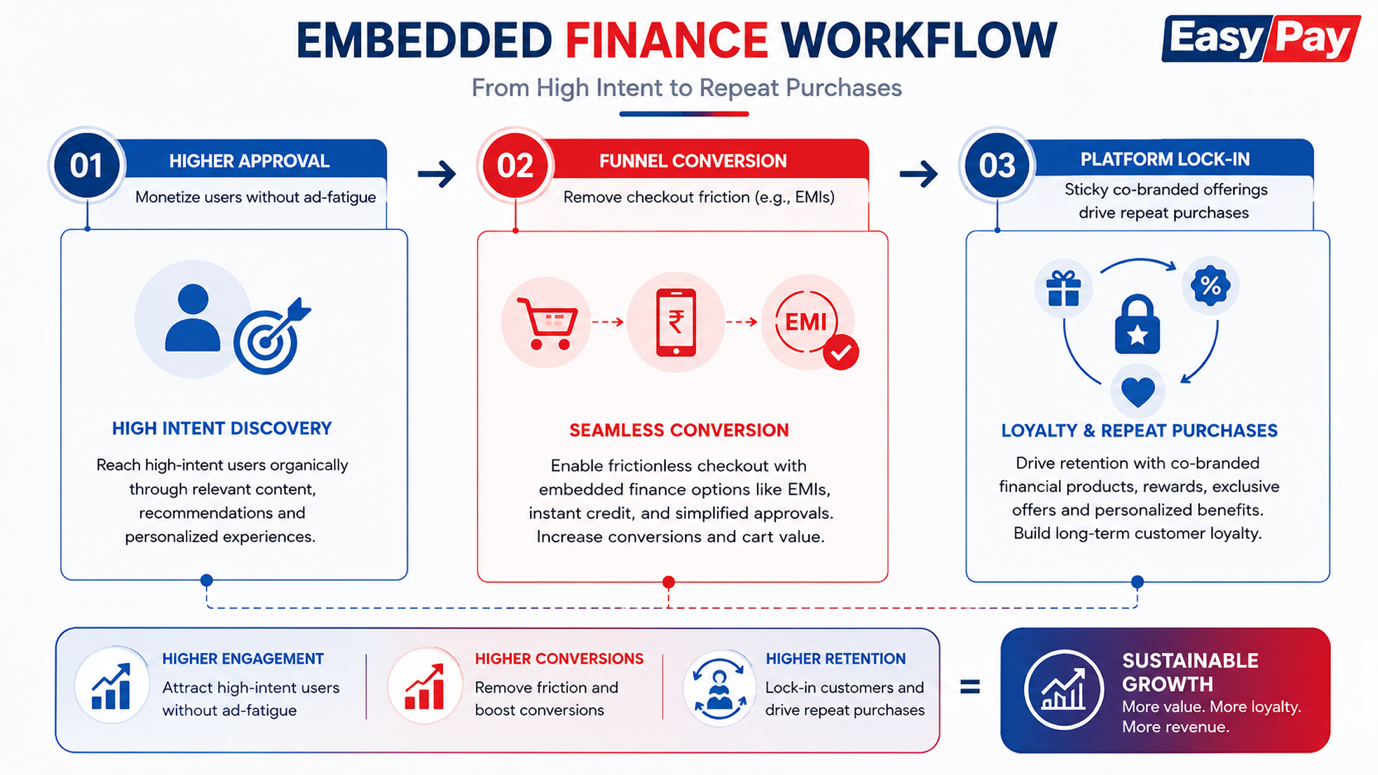
For an e-commerce platform, D2C brand, or digital commerce app, embedding fintech is no longer just a "nice-to-have" feature—it directly
impacts the bottom line:
Monetization (Boosting ARPDAU):Platforms hit a ceiling on how many ads they can display before damaging the user experience. Offering digital
financial products serves as a high-margin revenue lever to increase Average Revenue Per Daily Active User.
-
Higher Funnel Conversion:Financing removes purchase friction. With roughly 70% of iPhones in India purchased via EMIs,
offering embedded credit at checkout directly prevents abandoned carts.
-
Platform Lock-in: Products like Purchase finance and co-branded credit cards create deep consumer stickiness, ensuring
customers return to the same ecosystem for future orders.
India's Digital Public Infrastructure (DPI) & ONDC Catalyst
The rapid explosion of embedded finance across Indian e-commerce is propelled by India’s world-class Digital Public Infrastructure:
-
ONDC (Open Network for Digital Commerce): Demonstrating that wherever commerce moves, embedded finance follows—with
ONDC launching network-wide loans and insurance options.
-
Account Aggregator (AA): Enables seamless, consent-based financial data movement
directly from core banking systems to consumer apps, unlocking micro-lending and personal finance use cases.
-
DPDP Act (Digital Personal Data Protection): Strict data compliance pushes institutions to digitize and secure their tech
stacks, making compliant B2B data-sharing safer.
-
UPI & Advanced Mandates: Dynamic payment rails—including UPI Autopay and recurring mandates—make sachet-sized
recurring payments effortless.
-
ULI (Unified Lending Interface): Promoted by the RBI Innovation Hub to standardize data sharing, dramatically lowering
loan processing costs for small-ticket, short-duration credit.
The Paradigm Shift: What Changes Post-DPI?
In a post-DPI world where consumer data becomes democratized and accessible via open rails, the rules of competition change:
Traditional
Fintech Focus |
The New Post-
DPI Paradigm |
Why It Shifted |
| Access to Data |
Data Analysis &
Processing |
Data is accessible to licensed players;
competitive edge lies in fast, low-cost risk
processing.
|
| Scale |
Customer
Experience (CX) |
Scale no longer guarantees a data moat;
platform usability and seamless journeys
win users.
|
Product Feature
Set |
Margins & Unit
Economics |
Standardized infrastructure leads to similar
financial products; operational tech efficiency wins.
|
Business Opportunities: Scaling D2C Brands & E-Commerce Platforms
While B2B supply chains represent massive volume, Direct-to-Consumer (D2C)
brands and modern e-commerce platforms stand to gain some of the highest immediate
margin enhancements from embedded finance.
D2C brands face rising Customer Acquisition Costs (CAC), ad-fatigue, and high cart abandonment
rates. Embedding tailored financial services directly into the consumer buying journey converts
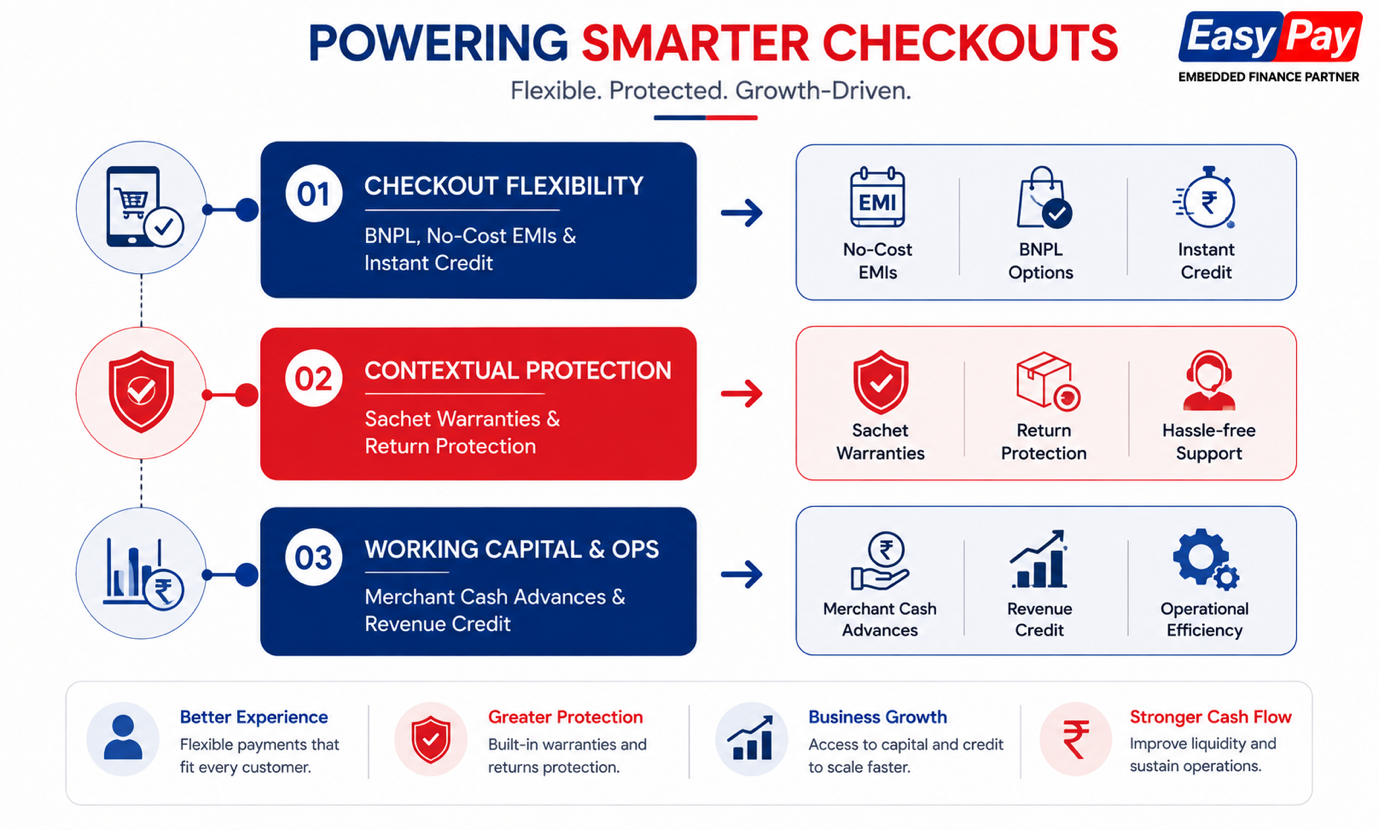
passive browsers into high-value repeat buyers across three key pillars:
Checkout Flexibility & Average Order Value (AOV) Expansion: Integrating pay-later options,
instant checkout credit, and no-cost EMIs removes price sensitivity at the point of purchase.
This directly reduces cart abandonment for high-ticket D2C products (electronics, fashion, beauty
appliances) and increases overall AOV.
-
Contextual Protection (Sachet Warranties & Cover): D2C brands can
offer low-ticket, high-margin add-ons at checkout—such as transit damage insurance,
extended warranties, or hassle-free return protection. These sachet products build buyer
trust while adding pure profit margin to every order.
-
Merchant-Side Working Capital & Inventory Financing:Beyond consumer-facing tools,
embedded fintech offers D2C brands data-driven merchant financing. By analyzing platform sales
velocity and inventory turnover, financial partners can extend instant working capital or revenue-based
financing to stock up ahead of festive sales seasons without diluting equity.
Where Infrastructure Partners Come In:
Integrating multiple credit engines, warranty providers, and payment gateways can be complex and resource-intensive for D2C brands whose core
focus is product design and brand building. Easy Pay acts as an Embedded Finance and ONDC technology infrastructure partner, enabling e-commerce marketplaces,
D2C brands, and digital commerce platforms to seamlessly integrate financial services into their customer and merchant journeys. By bridging open networks like
ONDC with modular financial middleware, infrastructure partners make deploying checkout finance, sachet protection, and merchant working capital a plug-and-play
experience.
Strategic Warning: Embedded Fintech Expands Margins—It Doesn’t Fix Bad Economics
The popular GEM Framework (Grow ➔ Engage ➔ Monetize via Fintech) has proven effective for consumer platforms monetizing user intent through credit and insurance. However,
e-commerce players must distinguish between traffic monetization and core business viability.
True Economic Product-Market Fit (PMF) requires that your core product engine achieves standalone unit profitability.
Embedded finance is not a subsidy for negative gross margins or high CAC. It is a high-margin margin multiplier meant to deepen retention and boost LTV on top of an already sound commercial model.
Conclusion
As India's digital public infrastructure matures and open networks expand, embedded finance will continue moving from an innovative add-on to an essential layer of modern digital trade. By collaborating
with infrastructure partners like Easy Pay, e-commerce platforms, D2C brands, and digital commerce applications can frictionlessly roll out tailored financial solutions right at the point of demand—winning
market share, increasing retention, and capitalizing on the $25 billion opportunity.